Body doubling for studying, explained
Body doubling for studying is the practice of working alongside another person — in person or in a live virtual room — so shared presence helps you overcome procrastination, initiate tasks, and maintain momentum. This guide provides practical productivity strategies, not medical advice, and does not claim clinical diagnosis or treatment.
Key takeaways
- Parallel co-working with live peer presence to disarm task initiation paralysis
- Particularly valuable for individuals navigating ADHD, executive dysfunction, or study isolation
- Completely non-verbal: cameras optional and microphones muted during focus blocks
- Open 24/7 across four versatile room formats with zero subscription barriers today
Body Doubling
Body Doubling
What is body doubling for studying on StudyLivo?
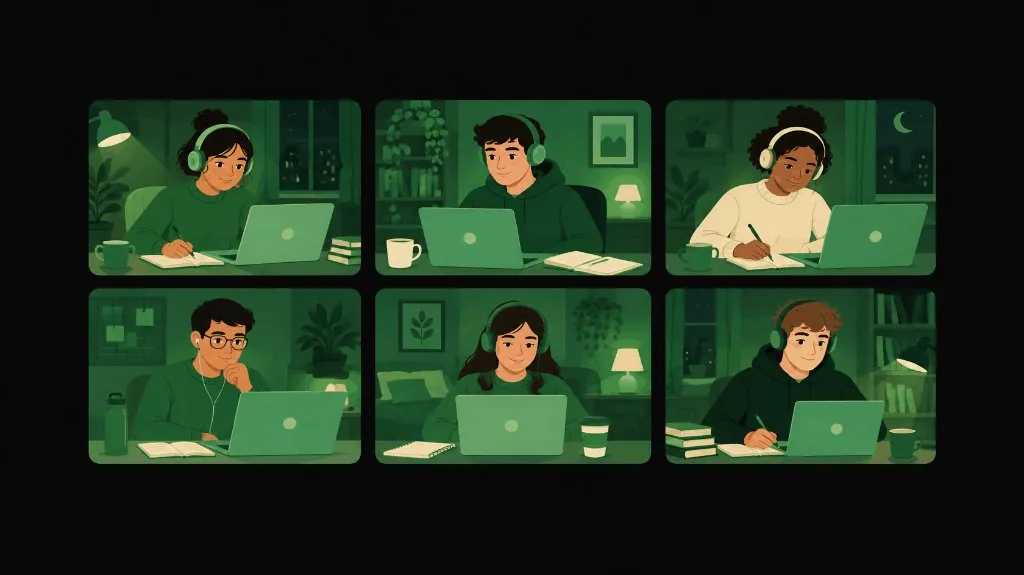
On StudyLivo, virtual body doubling takes place inside purpose-built online study rooms. Instead of sitting in an empty bedroom wrestling with the urge to avoid a daunting textbook or overdue project, you enter a digital space where fellow learners are actively working. You do not need to interact, explain your assignments, or ask for guidance. The mere visual presence of other people diligently focusing serves as a psychological stabilizer, lowering the emotional activation energy required to begin.
While body doubling originally emerged from ADHD coaching and neurodivergent community practices, its utility extends to anyone who finds solo studying lonely or prone to digital distractions. StudyLivo provides an accessible, non-judgmental environment where learners can tap into the power of shared presence at any hour of the day or night.
Focus Mechanics
Focus Mechanics
The executive function mechanics of virtual body doubling
To understand why body doubling works so reliably, it helps to examine the executive functioning challenges that lead to procrastination. When faced with an unstructured or cognitively demanding project, the prefrontal cortex often experiences executive dysfunction — an inability to prioritize steps, manage working memory, and generate the internal dopamine necessary to initiate action. In solitary environments, this friction frequently results in avoidance behaviors such as cleaning your desk, checking social media feeds, or daydreaming.
A body double functions as an external scaffold for your attentional system. Having another person visibly engaged in deep work provides external social cues that regulate your autonomic arousal. When your attention threatens to wander, glancing at a screen of peers quietly writing or reading triggers subconscious mirror neuron activity. This phenomenon, known in behavioral science as social anchoring, bridges the dopamine gap and makes sustaining focus significantly easier.
Four Room Styles
Four Room Styles
Choosing the right StudyLivo room for your body doubling style
Every individual has unique sensory sensitivities and pacing preferences. StudyLivo provides four distinct room settings to support different body doubling requirements:
- Silent Library Focus: A sensory-friendly sanctuary with software-locked microphones. Ideal for learners who are easily startled by sudden audio noises and crave quiet visual companionship.
- 25/5 Pomodoro Sprint: Combines body doubling with predictable temporal boundaries. The 25-minute sprints and 5-minute pauses prevent hyperfocus burnout and help manage time blindness.
- Deep Work Sanctuary: An open-ended, continuous virtual study hall that replicates the bustling, reassuring ambiance of a central university library for multi-hour sessions.
- Night Owls Collective: Tailored for night owls, delayed sleep phase schedules, and students whose mental clarity peaks late in the evening when the rest of the world is asleep.
5-Phase Flow
5-Phase Flow
Step-by-step body doubling workflow for tough study tasks
To get the maximum benefit from your virtual body doubling session, follow this proven five-phase protocol:
- Deconstruct the assignment: Break your intimidating project into micro-deliverables (for example: 'Drafting 200 words of the introduction' rather than 'Writing my entire research thesis').
- Prepare your physical space: Position your notepad, water bottle, and reference materials before joining the room to eliminate excuses to leave your desk early.
- Anchor your intention: Enter your selected StudyLivo room, adjust your video settings, and type your immediate micro-task into the in-room chat window.
- Monotask during the block: Keep only the necessary application or textbook open. If you feel an impulse to open an entertaining tab, look at your peers and take three deep breaths instead.
- Mark completion: Once your focus interval ends, tick off your completed item and step away from your workstation for a genuine break.
Navigating common body
Navigating common body
Navigating common body doubling challenges
While body doubling is exceptionally effective, keeping a few best practices in mind will ensure consistent long-term success:
- Managing camera fatigue: If looking directly into a webcam causes self-consciousness or social anxiety, point your camera downward to show only your desk surface and hands, or turn video off entirely. Body doubling benefits still occur when you observe others.
- Avoiding perfectionism: Some study sessions will be slower than others. Body doubling is about building consistency and showing up, not achieving flawless productivity every single day.
- Respecting the quiet norm: While in-room chat is wonderful for setting intentions and sending quick words of encouragement, avoid initiating long conversational debates that might disrupt the focus of fellow participants.
Practical scope and
Practical scope and
Practical scope and limitations: what body doubling can and cannot do
It is important to maintain realistic expectations regarding body doubling. Shared presence is a valuable behavioral technique and environmental support tool; it is not a clinical therapy, medical cure, or guarantee of examination success. StudyLivo provides virtual rooms and focus tracking to support your personal productivity routines. If you are struggling with severe mental health distress or clinical executive impairment, we strongly encourage consulting qualified healthcare professionals.
Choose a room. Sign in. Start a focus session.
Ready to join a room?
After you click, you continue in the StudyLivo web-app with your room selected.
Frequently asked questions
Why does having another person nearby help me focus?
Human attention is strongly influenced by social anchoring and behavioral contagion. Seeing others actively working signals your brain that it is time to focus, reducing task initiation resistance and impulsive distractions.
Is body doubling exclusively for people with ADHD?
Not at all. While popularized by ADHD coaches, body doubling is universally beneficial for students, remote professionals, writers, and anyone tackling solitary intellectual work.
Do I need to talk or interact with my body double?
No. Virtual body doubling is parallel work. You do not hold conversations or explain your tasks; you simply share the quiet environment and mutual presence while working on your own goals.
Can I participate in body doubling with my camera turned off?
Yes. Camera participation is entirely optional. Even with your own camera turned off, observing the focused presence of active peers in the room provides effective accountability.